How to Build a Growth Engine for Your Small Business (Complete Guide)
Most small businesses don’t have a marketing problem. They have a systems problem. Leads come in from one place, the sales team works out of another, customer data lives in five tools that don’t talk to each other, and nobody can connect the dollars spent on marketing to the deals that actually closed. The result is a business that works hard but grows unpredictably.
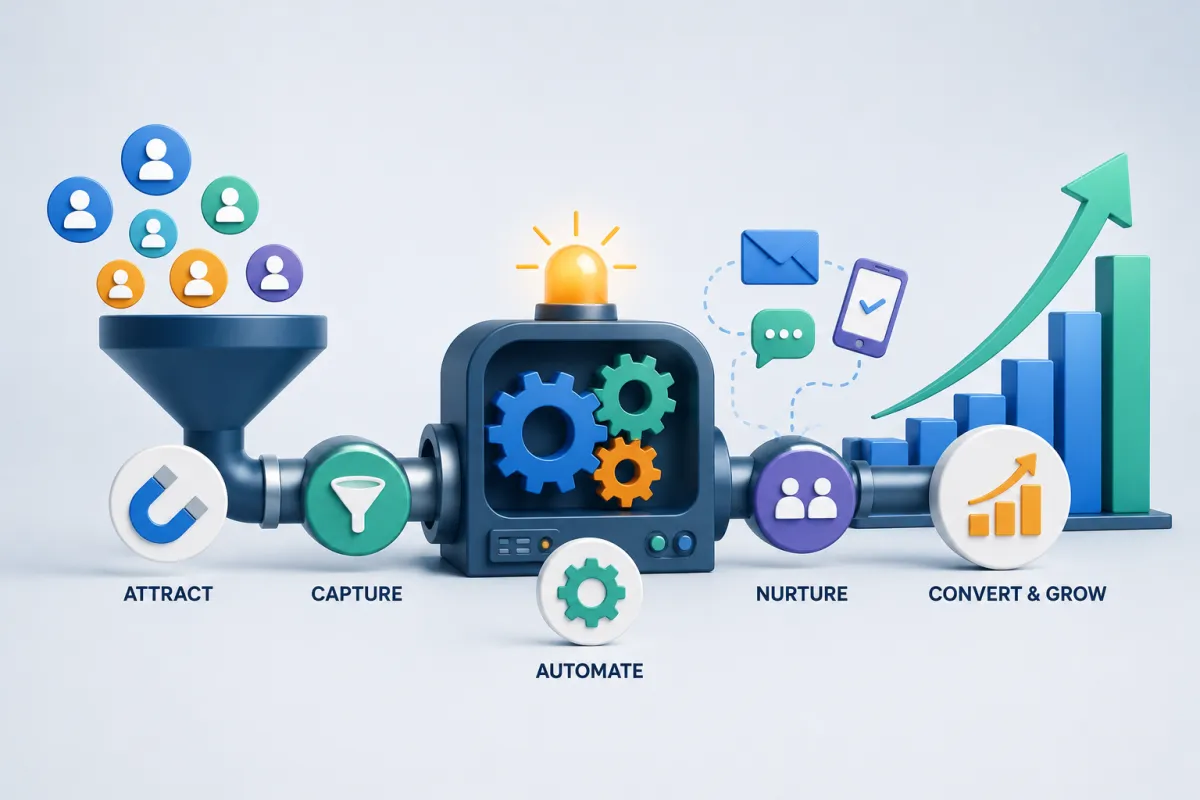
A growth engine fixes that. It’s a connected system — spanning lead generation, sales, automation, and retention — that turns attention into revenue on repeat, without you holding every piece together by hand. This guide walks through exactly how to build one.
What a growth engine actually is
A growth engine is not a campaign or a single tactic. It’s the infrastructure underneath your marketing and sales: the wiring that makes a lead automatically get followed up, a hot prospect automatically reach a salesperson, and a new customer automatically enter a retention flow. Campaigns feed the engine; the engine turns that fuel into predictable output.
The difference matters because campaigns stop the moment you stop pushing them. A system keeps running.
The five components every growth engine needs
1. Capture. Intentional, always-on channels that turn strangers into contacts — paid ads, SEO content, referrals, and lead magnets. Every channel must feed directly into your CRM, not a spreadsheet someone forgets.
2. Nurture. Automated follow-up that keeps you in front of leads who aren’t ready to buy today. This is where most “lost” revenue is hiding.
3. Convert. The booking system, sales follow-up, and automations that make sure no hot lead slips through the cracks between interest and purchase.
4. Deliver. A smooth onboarding and fulfillment experience, because growth that churns out the back door isn’t growth.
5. Retain and expand. Automated check-ins, review requests, and reactivation offers that turn one-time buyers into repeat customers and referrals.
How to build it in the right order
Don’t try to build all five at once. Start where you’re leaking the most money — usually follow-up. Fix instant lead response first, then nurture, then capture more aggressively once the back end can handle volume. Pouring leads into a broken funnel just wastes them faster.
Map your current customer journey on paper before you automate anything. Automation amplifies whatever process you point it at, so the process has to be right first.
How to know it’s working
A real growth engine shows up in your numbers: a rising lead-to-customer conversion rate, a shorter sales cycle, a lower cost per acquisition, and revenue you can forecast instead of guess. If you can’t tie marketing activity to closed revenue, you don’t have an engine yet — you have disconnected parts.
Building that connected system is exactly what a growth agency does, and it’s the difference between getting busier and actually scaling. Explore how the pieces fit together in our growth marketing and sales systems services.
Want a growth system built around your numbers, not vanity metrics? Book a free growth strategy call — no pitch deck, just a real conversation about where you are and how to get where you’re going.
